

Therapeutic Plasma Exchange (TPE) in Scottsdale
We make it easy for you to get TPE so you can get the treatment you need, feel the difference and see it in your labs. One call gets you straight answers on fit and the full cost.
- Automated apheresis system
- Single-use sterile tubing set
- Prescription procedure, clinician oversight
- Full cost stated up front
Part of Blood Rehabilitation:RemoveRestoreSupport
- 8090 N. 85th Way, Suite 100, Scottsdale, AZ 85258
- (623) 294-5577
- Monday to Friday, 9 a.m. to 5 p.m.

What builds up, and what we take out
Plasma is the liquid part of your blood. Along with everything you need, it can carry things you’d rather have less of. Plasma exchange takes out a share of that plasma, and what it carries, then gives you back your own blood cells with a clean replacement.
What builds up
- Cholesterol particles ApoB and LDL, the ones your heart numbers track.
- Inflammatory proteins The signals that keep inflammation switched on.
- Antibodies Including the ones behind some autoimmune conditions.
- Everyday chemicals PFAS, known as forever chemicals, and microplastics.
What we take out
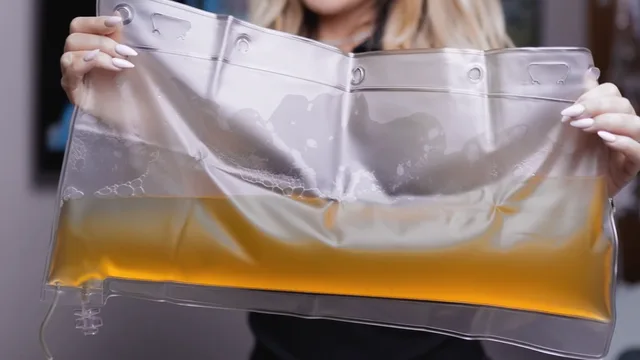
A share of your plasma, and what it carries. You can see it leave.
What you get back
- Your own blood cells, returned with clean replacement fluid, usually albumin.
- Your numbers, side by side. The same lab panel before and after, so you can see what changed.
- A plan for what comes next. We go through the change with you and map out your next steps together.
How much any one marker moves depends on the marker and on you. See the evidence for each use, or look at a sample report.
Before you decide
TPE physically takes out a share of your plasma and what it carries, then puts back a clean replacement. Hospitals have used it for decades, and newer research is looking at biological age, microplastics and brain health.
Blood rehabilitation is all we do. You get your own private suite, a dedicated provider beside you for the whole procedure, and a plain statement of the evidence for your use before you decide.
You can’t measure change without a starting point, and your baseline labs give you one. One call tells you whether a consultation is worthwhile, with no commitment.
Want to see what you would get? See a sample before-and-after report.
What plasma exchange is, and how it works
- 01
Access
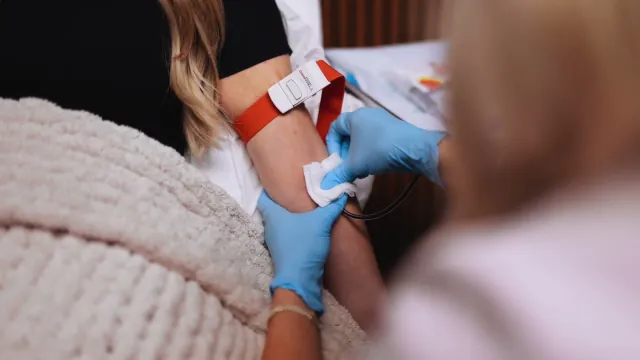
Blood is drawn through a needle in a vein (usually in the arm) or, for some patients, through a catheter.
- 02
Separation
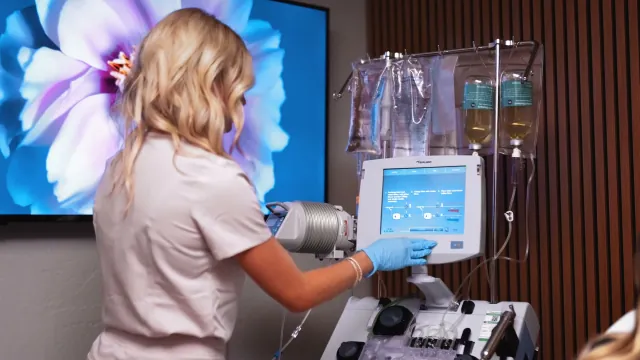
The blood flows slowly through a machine that separates plasma from blood cells, by spinning in a specialized centrifuge.
- 03
Replacement
The removed plasma is discarded and replaced with an equal volume of fluid – a solution of albumin (the main protein in plasma) mixed with saline. Because volume goes in as it comes out, blood pressure and circulation stay stable.
- 04
Return
Your own blood cells, combined with the replacement fluid, are returned to you.
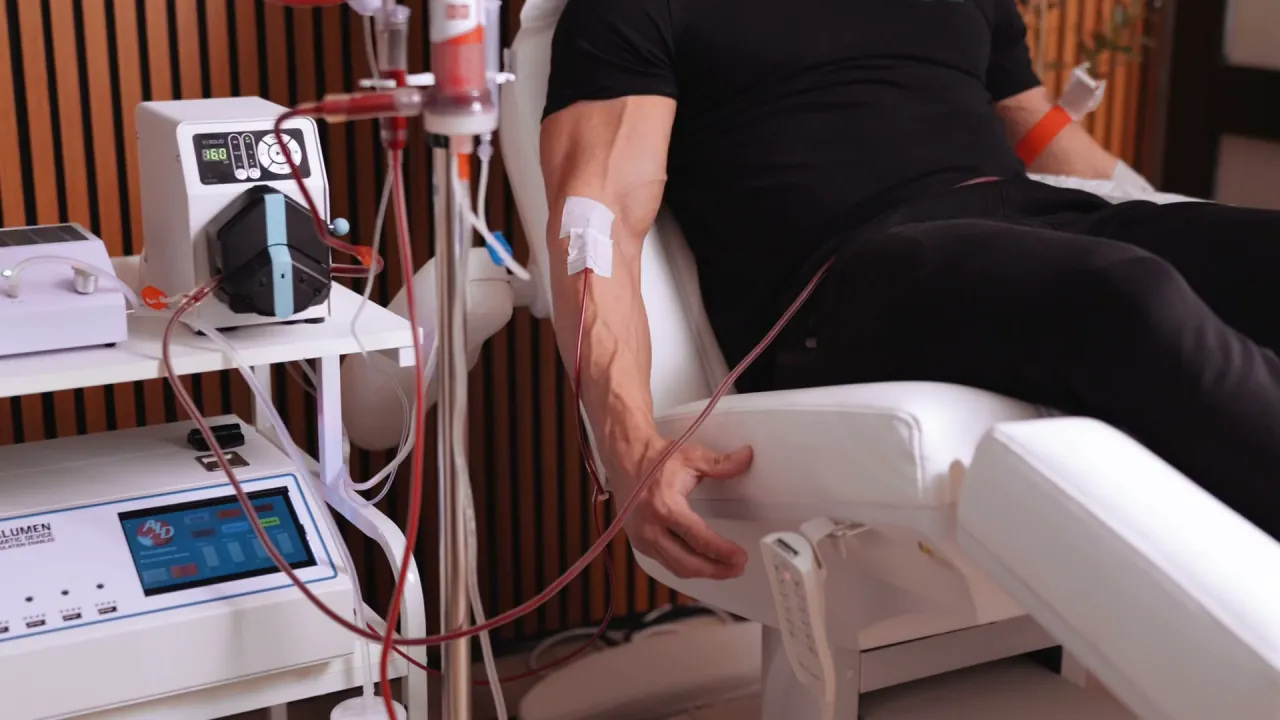
The process of Therapeutic Plasma Exchange (apheresis) explained: Plasma is the liquid part of your blood. It carries antibodies, clotting factors, inflammatory signals, toxins, and microplastics. In therapeutic plasma exchange (TPE), a portion of your blood is drawn through a sterile, single-use tubing set and mixed with an anticoagulant. A centrifuge separates the plasma from your blood cells. The plasma is removed, a replacement fluid (usually albumin) is added, and your blood cells are returned to you.²,⁵
That is the whole idea: take out a share of the plasma and what is carried in it, and put back a clean replacement. Which substances matter depends on the person. In some medical conditions the harmful substance is an antibody, and removing it is an accepted treatment under specialist care.³,⁴ For other uses, including those we offer, researchers are studying whether plasma exchange lowers circulating inflammatory proteins⁶,⁷ or other plasma-borne substances.¹⁰
A typical session treats about 0.5 to 1.5 times your total plasma volume – roughly 2.5–2.7 liters of plasma for a 70 kg adult. Treating one plasma volume removes a large share, but not all, of a given substance, and levels can rebound afterwards as the body makes more or as it moves back into the blood from tissues. That is why treatment is usually given as a series of sessions rather than once.
This is a technology-dependent, physical procedure, not a supplement or an IV drip.
What the evidence supports
TPE has been used in hospitals for decades. Due to the increasing availability of TPE and similar blood rehabilitation technologies, there are a number of areas of emerging interest. Plasma exchange is an established treatment for some medical conditions, studied for others, and early for the uses we offer. The American Society for Apheresis (ASFA) publishes evidence-based guidelines that rank conditions by how strong the evidence is. Here is where some applications stand:
- Established: ASFA’s top category ("first-line" treatment) includes Guillain-Barré syndrome, thrombotic thrombocytopenic purpura (TTP, a dangerous blood-clotting disorder), myasthenia gravis flare-ups, chronic inflammatory demyelinating polyneuropathy (CIDP), anti-GBM (Goodpasture) disease, severe ANCA-associated vasculitis affecting the kidneys, symptomatic blood hyperviscosity, and acute liver failure. These are typically treated by specialists in hospital settings.
- Studied: ASFA lists many more conditions where TPE is a reasonable option or where evidence is still developing – for example multiple sclerosis relapses, neuromyelitis optica, severe lupus, thyroid storm and some poisonings. In Alzheimer's disease, the AMBAR trial is the largest randomized study of plasma exchange to date and showed encouraging results.
- Emerging: There are a number of exciting emerging studies showing early evidence for a wide range of uses, such as biological age and chemical removal. Wellness and biological-age uses are new. One small, randomized trial (42 adults over 50) demonstrated changes in "biological age" markers after TPE. Studies published in 2026 have reported lower circulating microplastic and PFAS ("forever chemical") levels after apheresis in some patients.
- Limited: Some people ask about TPE for situations such as mold (mycotoxin) or pesticide exposure, fertility preparation, or menopause symptoms – these areas are not yet supported by large clinical trials. Where we discuss these, we do so as an area of emerging interest.
Who it may suit
TPE at Clearegen is offered after a medical assessment. It is not a substitute for care from your own doctors, and it is not suitable for everyone.
Biological age
Move from wondering how you’re aging to measuring it. Track your biological-age markers before and after TPE, an emerging approach backed by early research. See TPE for Biological Age.
Autoimmune & chronic inflammatory conditions
Add another option to your care, alongside your specialist. TPE has its longest clinical track record in diagnosed autoimmune conditions. See TPE for Autoimmune & Inflammatory Conditions.
Cardiovascular health
Take your lipids and cardiovascular numbers from a concern to a plan. TPE supports your cardiology care, with ApoB and LDL tracked before and after. See TPE for Cardiovascular Health.
Brain health & cognitive function
Be proactive about the health of your brain. Explore plasma exchange informed by the AMBAR Alzheimer’s trial, an investigational area still being studied. See TPE for Brain Health & Cognitive Function.
Environmental exposure
Go from worrying about microplastics, PFAS, mold and pesticides to knowing your levels and doing something about them. We measure your exposure markers and explore TPE as an emerging option for lowering circulating levels. See TPE for Environmental Exposure.
Women’s health
Feel confident about what’s in your body at every stage, from preparing for pregnancy to perimenopause and beyond. We measure everyday chemical exposures and inflammation, guide simple swaps, and track your progress in your own results. See TPE for Women's Health.
Evidence differs by area; each page shows where it stands.
Our equipment and team
We perform plasma exchange on a state-of-the-art, automated, FDA-cleared apheresis system designed for therapeutic plasma exchange.¹ Every session uses a new, sterile, single-use tubing set, and the system keeps less than a cup of your blood outside your body at any time.² Every session takes place in your own private suite, never a shared treatment room, with a dedicated provider by your side for the entire procedure. Plasma exchange is a prescription procedure carried out by qualified medical personnel.²
FDA clearance applies to the device. It does not mean the FDA has evaluated plasma exchange for biological aging, detoxification or wellness, and we do not claim that it has.
How a series works
- You call. We answer your questions and tell you whether a consultation is worthwhile. No commitment.
- Consultation. We review your history and medicines, discuss what plasma exchange might and might not do for you, and cover risks and alternatives.
- Your decision. You decide, with the full cost in front of you. Plasma exchange is a choice, not the starting point.
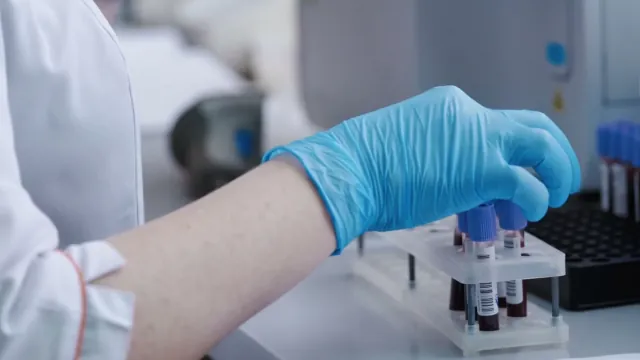
- Baseline tests. We measure what is relevant to your reason for coming, so there is a before.
- Your ClearCycle™ series. A planned series of plasma exchange sessions at the tier we agree with you.
- Fixed-time re-test. The same tests, drawn at a set time after the series, so you can see what changed.
- Review. We go through the change together and share it with your own clinician, with your consent. What comes next is your decision.
The three exchange tiers
The ClearCycle™ tiers are named for the percentage of your calculated plasma volume that is exchanged: 50, 100 or 150. Your plasma volume is worked out from your size and blood count. In clinical practice, an exchange is usually 1 to 1.5 plasma volumes,⁴ so 100 equals one plasma volume and 150 is the top of the usual range; 50 is smaller than usual, and the evidence for smaller exchanges is limited.⁸ Full fees and what’s included at each tier: TPE Fees & Packages.
What a session is like
A calm, private experience from the moment you arrive.
1. Arrive and settle in
You’re greeted on arrival and taken straight to your own private suite. There’s no waiting room and no shared treatment space.
2. Check in with your provider
Your dedicated provider reviews your health, medications and vital signs, and walks you through the session ahead. They stay with you throughout.
3. Comfortable IV access
A small IV is placed in one or both arms.
4. Plasma exchange
The system gently separates your plasma, exchanges a carefully calculated volume, and returns your own blood cells to you. Your provider monitors you continuously. Sessions take 90 minutes to 4 hours depending on your program.
5. Monitored recovery
After your session, you rest in your suite while your provider checks your vital signs and makes sure you feel ready to go.
6. Head home
You leave with aftercare guidance and a clear plan for your next visit.
Full step-by-step walkthrough: ClearCycle™ Protocol & Process. TPE Fees & Packages.
Risks and safeguards
Plasma exchange is a well-established procedure with known risks.¹¹ The most common are discomfort or bruising where the needle goes in, lightheadedness, low blood pressure, nausea, and tingling around the mouth or in the fingers, which can happen because the anticoagulant lowers calcium for a while.⁴,⁵,¹¹ Less often: allergic reactions to the replacement fluid, infection at the access site, and changes in blood clotting.⁴,⁵,¹¹ The manufacturer also lists low albumin and low antibody levels among known effects of apheresis.²
Tell us if you take blood pressure medicines (some types, such as ACE inhibitors, can lower blood pressure further during exchange), have a bleeding or clotting condition, take medicines that are carried on proteins in the blood, have had immunoglobulin infusions or monoclonal antibody treatments, or have allergies.⁴ We do not provide plasma exchange to anyone who is pregnant, actively trying to conceive, or in active fertility treatment. We will not start a series without reviewing this with you. Read more on our Safety & Clinical Standards page.
Cost
We tell you the full cost before you decide. Plasma exchange for elective wellness use is generally not covered by insurance and is a direct-pay service. See ClearCycle™ fees and Vitality Cascade fees.
Your clinical team
Your care comes from a dedicated blood rehabilitation team of experienced registered nurses, nurse practitioners and clinicians. You will meet more than one of us, and one dedicated registered nurse stays with you, one-on-one, for the entire procedure.
The team is led by our Clinic Director, David George, FNP-BC:
- Board-certified family nurse practitioner (FNP-BC)
- Trained and experienced in therapeutic plasma exchange
- Member, American Society for Apheresis (ASFA)
Frequently Asked Questions
Does plasma exchange work?
It depends on what it is used for. It is an established treatment for some medical conditions under specialist care,³,⁵ studied for lowering circulating inflammatory proteins in people being treated for other conditions,⁶,⁷,⁸ and early for the uses we offer. We do not tell visitors that it will improve how they feel, and we measure your own numbers before and after so you can see what changed.
Is TPE the same as plasmapheresis?
Plasmapheresis is the general term for separating plasma from blood. Therapeutic plasma exchange is the version that replaces the removed plasma with a substitute such as albumin.⁴
Is the machine FDA-approved?
The apheresis system we use, the Spectra Optia, has an FDA 510(k) clearance for therapeutic plasma exchange.¹ A clearance is a different regulatory decision from an approval, and it applies to the device. It does not mean FDA has evaluated plasma exchange for biological aging, detoxification or wellness.
Is it safe?
It is a well-established procedure with known risks, including low blood pressure, tingling from low calcium, bruising at the needle site, allergic reactions to the replacement fluid, infection and changes in clotting.⁴,⁵,¹¹ We review your history and medicines first and monitor you throughout. The full list is in the risks block above.
Does it remove toxins?
It removes plasma and what is carried in it. Whether a particular substance is removed, and whether removing it helps, depends on the substance and the person. A small 2026 report found lower circulating microplastic counts after plasma exchange;¹⁰ it did not show a health benefit. A small 2025 hypothesis paper reported lower urinary levels of some synthetic chemicals after serial exchange plus supplements,¹² with no control group. We do not claim to remove toxins, and we can test before and after so you can see for yourself.
How long does a session take?
90 minutes to 4 hours, depending on the tier and your personal physiologic factors.
How many sessions will I need?
You decide with us whether to repeat a series after the re-test. There is no fixed schedule that we can show helps, so we do not set one in advance. See our Frequency & Maintenance guidance.
Is it covered by insurance?
Generally not, for elective use. It is a direct-pay service, and we give you the full cost before you decide.
Do I need to stop my medicines?
Never stop a medicine on your own. Some medicines are removed with the plasma, and some treatments, including immunoglobulin infusions and monoclonal antibodies, are extensively removed, so timing matters.⁴,⁵ Tell us everything you take, and we will plan around it with your prescriber.
Can my own doctor be involved?
Yes, and we encourage it. With your consent we share your results with your clinician.
I live out of state. Can I still come?
Yes; speak with us before booking travel. See the out-of-state block for what to ask.
Talk it through before you decide
Call (623) 294-5577, Monday to Friday, 9 to 5. A member of our clinical team will answer your questions, tell you whether a consultation is likely to be worthwhile, and give you the full cost. No obligation. Prefer to prepare first? Use our consultation guide: four questions to take to any clinic, including ours.
Plasma exchange is an established treatment for some medical conditions. For the uses on this page it is an elective choice with early evidence and known procedural risks, and it carries no promise of benefit. Your own clinicians stay involved in your care, and you decide.
Sources
- US Food and Drug Administration. 510(k) premarket notification K172590: Spectra Optia Apheresis System. Terumo BCT, Inc. Decision: substantially equivalent, March 2, 2018. Product code LKN.
- Terumo Blood and Cell Technologies. Patient Guide: Therapeutic Plasma Exchange. Terumo BCT, Inc; 2023. Document TS-OPTI-02036.
- Connelly-Smith L, Alquist CR, Aqui NA, et al. Guidelines on the use of therapeutic apheresis in clinical practice: evidence-based approach from the Writing Committee of the American Society for Apheresis: the ninth special issue. J Clin Apher. 2023;38(2):77-278. doi:10.1002/jca.22043
- Godbey EA. Therapeutic plasma exchange (TPE). PathologyOutlines.com. Updated February 2, 2022.
- Rony RMIK, Shokrani A, Malhi NK, et al. Therapeutic plasma exchange: current and emerging applications to mitigate cellular signaling in disease. Biomolecules. 2025;15(7):1000. doi:10.3390/biom15071000
- Schmidt JJ, Jahn J, Golla P, et al. Effect of therapeutic plasma exchange on plasma levels and total removal of adipokines and inflammatory markers. BMC Obes. 2015;2:37. doi:10.1186/s40608-015-0067-z
- Zhang J, Xie D, Tang M, et al. Utilizing plasma exchange for severe cytokine release syndrome after CAR-T cell therapy: clinical experience and literature insights. Front Immunol. 2025;16:1597512. doi:10.3389/fimmu.2025.1597512
- Slavic V, Antunovic T, Randjelovic D, Terzic Stanic N, Boljevic J. Therapeutic role of low-volume plasma exchange in modulating lipopolysaccharides-binding protein and inflammatory pathways in metabolic syndrome. Arch Med Sci Atheroscler Dis. 2026;11(1):17-23. doi:10.5114/amsad/216575
- Boada M, López OL, Olazarán J, et al. Primary results of the AMBAR Study. Alzheimers Dement. 2020;16(10):1412–1425.
- Weinstein R, Yüksel ZS, Anderson C, et al. Can plasma exchange be used to lower the circulating burden of microplastics in human patients? J Clin Apher. 2026;41. doi:10.1002/jca.70135
- Altobelli C, Anastasio P, Cerrone A, et al. Therapeutic plasmapheresis: a revision of literature. Kidney Blood Press Res. 2023;48(1):66-78. doi:10.1159/000528556
- Savage P, Anderson PS, She J-X, Smith PW, Hanaway P, Basiorka R. Can serial therapeutic plasma exchange remove synthetic chemicals from humans? Med Hypotheses. 2025;198:111630.
- Fuentealba M, et al. Multi-omics analysis reveals biomarkers that contribute to biological age rejuvenation in response to single-blinded randomized placebo-controlled therapeutic plasma exchange. Aging Cell. 2025;24(8):e70103. doi:10.1111/acel.70103
- Kim D, Kiprov DD, Luellen C, Lieb M, Liu C, Watanabe E, Mei X, Cassaleto K, Kramer J, Conboy MJ, Conboy IM. Old plasma dilution reduces human biological age: a clinical study. GeroScience. 2022;44(6):2701-2720.
Looking for TPE in the United States, including California and surrounding states?
Clearegen’s clinic is in Scottsdale, Arizona, and we welcome patients from across the United States and from abroad. Many travel here to enjoy Arizona’s climate and a private, luxury clinical setting. If you are considering a visit from California, a neighboring state or anywhere else, speak with the team before booking travel. Plan your out-of-state consultation questions.
- Ask how to begin the consultation and assessment process.
- Confirm appointment availability and the time you would need for your individual plan.
- Discuss follow-up and travel questions with the treating team.
- Ask which secure channel to use for any clinical information; keep health details off the website and ordinary email.
Questions worth asking any clinic, including ours.
Before you decide, ask us these. We’ll answer them plainly.
- What is the evidence for this use of TPE, and how strong is it?
- What will my Focused panel measure, what would an Expanded panel add, and how will we know what changed?
- What are the risks, and who should not have this procedure?
- What will it cost in total? (The Focused panel is included; the Expanded panel is an additional fee.)
- How will my own physician or clinician be kept informed?
Call us or send a request online, and our clinical team will answer your questions and set up a consultation.
Visit or call the clinic
Blood Rehabilitation Centers, Scottsdale, Arizona. Call us or send a request online, and our clinical team will answer your questions and set up a consultation.
Call (623) 294-5577- 8090 N. 85th Way, Suite 100, Scottsdale, AZ 85258
- Monday to Friday, 9 a.m. to 5 p.m.
What would you like to understand?
Browse all pages
- Home
- Blood Rehabilitation
- How We Prove It
- Programs
- The Vitality Cascade
- Membership
- TPE / Plasmapheresis
- TPE Fees & Packages
- How ClearCycle™ TPE Works
- The Evidence Behind TPE
- TPE Patient Experience
- eBoo
- EBO2 Fees & Packages
- How EBO2 Works
- EBO2 Patient Experience
- Safety & Standards
- Dr. David George
- Team
- For referring clinicians
- Contact Us in Scottsdale
- Frequently Asked Questions
- Privacy
- Terms & Conditions
- Cookie Policy
- Accessibility
- TPE for Biological Age
- TPE for Autoimmune & Chronic Inflammatory Conditions
- TPE for Cardiovascular Health
- TPE for Brain Health & Cognitive Function
- TPE for Environmental Exposure: Mold, Microplastics & Environmental Toxins
- TPE for Women’s Health
- Cardiovascular Health Program
- Biological Age
- Brain Health
- Autoimmune
- Environmental Exposure Program
- Women’s Health
- Performance Blood Health
- AMBAR trial summary