

TPE for Biological Age
We help adults who want to manage how they age by measuring biological-age and inflammation markers before and after a planned series of plasma exchange sessions, so they can see their own numbers change instead of guessing.
Part of Blood Rehabilitation:RemoveRestoreSupport
- 8090 N. 85th Way, Suite 100, Scottsdale, AZ 85258
- (623) 294-5577
- Monday to Friday, 9 a.m. to 5 p.m.
Want this measured, not just discussed?
The scope of the problem
Aging itself isn't a diagnosis, but the biological processes associated with it — chronic low-grade inflammation, accumulation of senescent-cell signaling factors, and oxidative damage to circulating proteins — are increasingly measurable, and increasingly linked to the onset of age-related disease well before any single condition is diagnosed. The wellness and healthy-aging population is, functionally, everyone eventually; you may want to understand what these measurable changes mean for your own health.
How it's approached today
Most healthy-aging interventions — exercise, caloric and time-restricted eating, sleep optimization, and supplement or peptide protocols — work by slowing future accumulation of aging-associated damage. Few directly remove what has already accumulated in circulation.
The unmet need
Your clinical team can explain which circulating components TPE removes, where the evidence applies, and what the protocol cannot promise.
Where TPE may help — the specific markers involved
A 2022 clinical study by researchers affiliated with the Conboy Lab at UC Berkeley and the Buck Institute directly measured a panel of aging-associated proteins before and after plasma dilution and exchange.¹ Markers that decreased included 8-OHdG (a marker of oxidative DNA damage), p16 (a marker of cellular senescence), TDP-43 (associated with neurodegeneration), macrophage activation markers CD11b and CD68, and a cluster of pro-inflammatory signaling proteins including CCL20, CCL25, MIF, TLR3, TLR4, IL-2RA, and IL-16. Markers that increased — moving in the healthier direction — included T-cell markers (CD3, CD4, CD8), B-cell markers (CD19, B220), the NK-cell marker CD94, the lymphoid-to-myeloid ratio (a ratio that skews unfavorably with age), and the tumor-suppressor proteins p21 and p53. The same study proposed a novel biological-age measure built from a ten-protein panel, which decreased following the procedure.¹ A separate 2025 multi-omics analysis of therapeutic plasma exchange independently identified biomarkers associated with biological-age rejuvenation using a single-blinded, randomized, placebo-controlled protocol.² This is an active, evolving research area — protocols, populations, and endpoints vary considerably between studies, individual marker panels vary by lab, and individual results are not guaranteed.
What the studies show, and what we do not know
“Biological age” is an estimate, based on blood and molecular markers, of how your body is aging compared with your calendar age. It is a measurement, not a diagnosis, and different tests can give different answers.
What the studies show. In a 2025 randomized, placebo-controlled trial of 42 healthy adults over 50, people who had plasma exchange scored lower on several biological-age measures than people who had a placebo. Smaller human studies point the same way. In the studies that found a benefit, the largest changes came after the first few sessions. One report says people who started with less healthy markers changed the most. In animal studies (specifically in aged mice), exchanging old plasma for a saline-and-albumin solution, with no young blood, improved measures of muscle repair, liver scarring, and new nerve cell growth in the brain. That said, animal results often do not carry over to people.
What we do not know. These human studies are small and early. They measured markers, not longer life or fewer illnesses, and no study has tested either one. Results have not yet proven to be consistent.
Where this leaves us. Based on the limited body of research on this topic, using plasma exchange to affect biological age is still a research question. It may suit adults who want to track their own aging markers and understand that the evidence is preliminary. We measure your labs before and after, so you see your own change, whatever it turns out to be.
What happens in a session
- Blood out.
- Plasma separated and replaced.
- Blood returned.
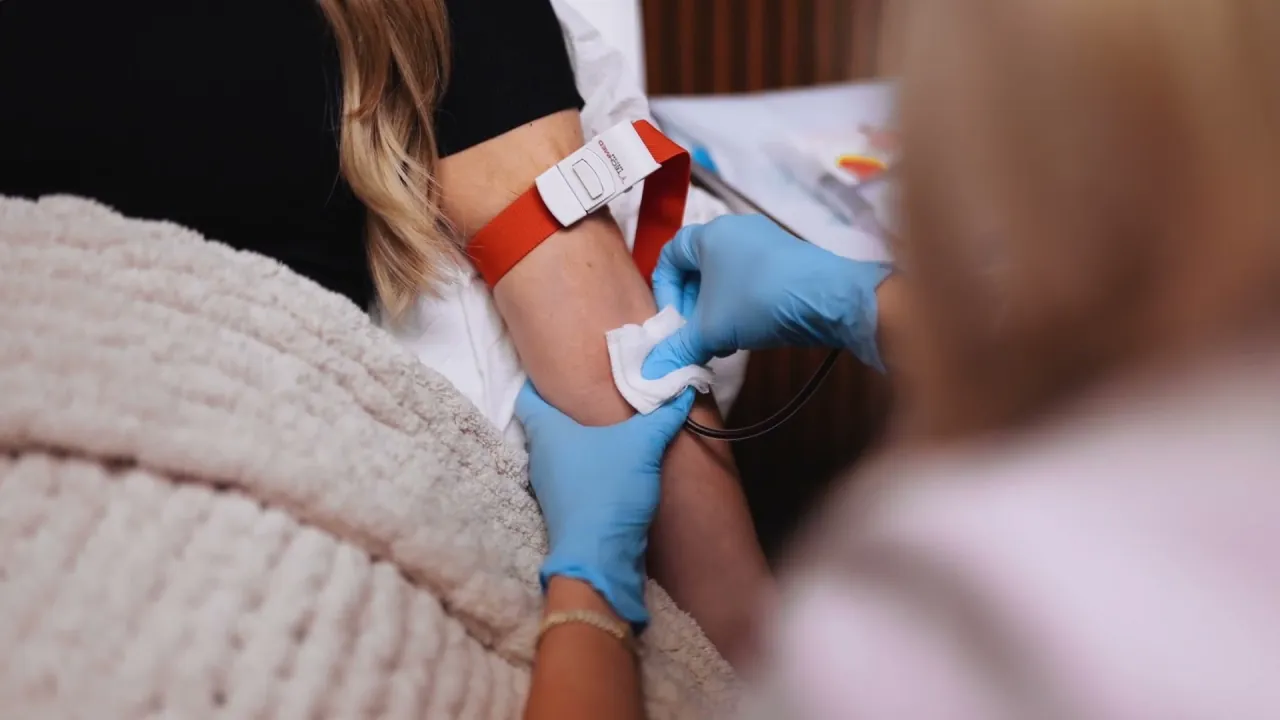
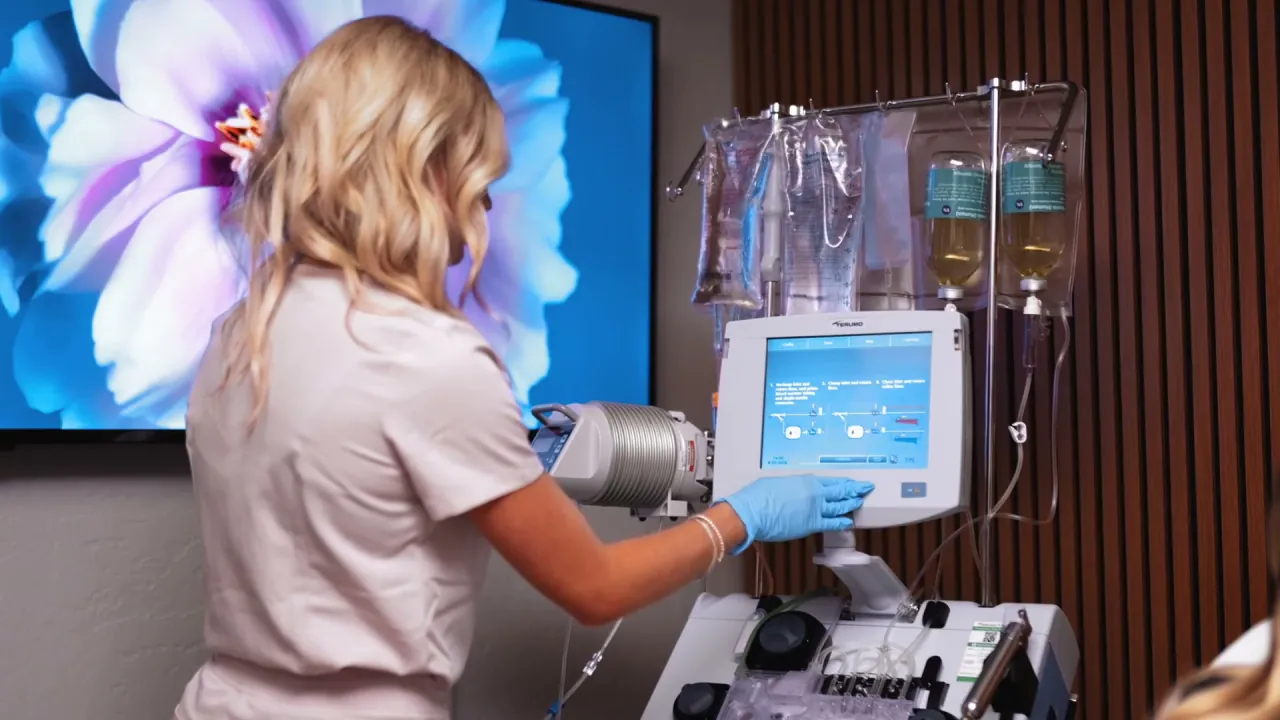
What happens in a session. Blood is drawn, the liquid part (plasma) is separated from the blood cells, and the plasma is replaced with a sterile replacement fluid, usually albumin, before the cells are returned. In effect, part of the plasma and what it carries is removed and replaced.
What may change in the blood. Plasma exchange removes a portion of circulating proteins, including inflammatory mediators and, in other conditions, autoantibodies and immune complexes. Levels can rebound, which is why a planned series is used.
What is not known. A change in a lab value does not by itself mean a change in your health. Epigenetic aging tests are a research-grade wellness metric, not a diagnostic test. We will not promise a result.
What we measure, before and after
You get the full aging-biomarker panel below, tested before and after and delivered directly to you.
- Epigenetic pace-of-aging test (DNA methylation-based) — a peer-reviewed, replicated biomarker of biological aging rate³
- hs-CRP and IL-6 — "inflammaging" markers
- Comprehensive metabolic panel and CBC
- Hormone panel as clinically appropriate
You might consider this track if you're...
- Already tracking your own biomarkers annually and looking for an intervention with a measurable before/after
- Someone whose routine labs show elevated inflammatory markers without an active diagnosis
- Preparing for a milestone decade — a way to mark it with something concrete rather than symbolic
- Already running a healthy-aging stack (peptides, NAD+, cold/heat exposure, rigorous bloodwork) and looking for the next lever
References
- Kim D, Kiprov DD, Luellen C, Lieb M, Liu C, Watanabe E, Mei X, Cassaleto K, Kramer J, Conboy MJ, Conboy IM. Old plasma dilution reduces human biological age: a clinical study. GeroScience. 2022;44(6):2701-2720.
- Fuentealba M, et al. Multi-Omics Analysis Reveals Biomarkers That Contribute to Biological Age Rejuvenation in Response to Single-Blinded Randomized Placebo-Controlled Therapeutic Plasma Exchange. Aging Cell. 2025.
- Belsky DW, Caspi A, Corcoran DL, et al. DunedinPACE, a DNA methylation biomarker of the pace of aging. eLife. 2022;11:e73420.
- Borsky P, Holmannová D, Párová H, et al. Human clinical trial of plasmapheresis effects on biomarkers of aging (efficacy and safety trial). Scientific Reports. 2025;15. doi:10.1038/s41598-025-05396-0
- Fuentealba M, Kiprov D, Schneider K, et al. Multi‐Omics Analysis Reveals Biomarkers That Contribute to Biological Age Rejuvenation in Response to Single‐Blinded Randomized Placebo‐Controlled Therapeutic Plasma Exchange. Aging Cell. 2025;24. doi:10.1111/acel.70103
- Gulej R, Patai R, Ungvari A, et al. Plasma-based strategies for systemic rejuvenation: critical perspectives on clinical translation. GeroScience. 2026;48:4571 - 4584. doi:10.1007/s11357-026-02136-8
- Kim D, Kiprov D, Luellen C, et al. Old plasma dilution reduces human biological age: a clinical study. GeroScience. 2022;44:2701 - 2720. doi:10.1007/s11357-022-00645-w
- Liu S, Wang S, Dong Y, Yang S, Yao C. Research progress on blood therapy for anti-aging. Journal of Advanced Research. 2025;82:981 - 998. doi:10.1016/j.jare.2025.07.039
- Rony R, Shokrani A, Malhi N, et al. Therapeutic Plasma Exchange: Current and Emerging Applications to Mitigate Cellular Signaling in Disease. Biomolecules. 2025;15. doi:10.3390/biom15071000
TPE for biological-age optimization is an elective wellness service. It is not intended to diagnose, treat, cure, or prevent any disease, and claims about biological age reduction reflect general research findings, not a guaranteed individual outcome.
Questions worth asking any clinic, including ours.
Before you decide, ask us these. We’ll answer them plainly.
- What is the evidence for this use of TPE, and how strong is it?
- What will my Focused panel measure, what would an Expanded panel add, and how will we know what changed?
- What are the risks, and who should not have this procedure?
- What will it cost in total? (The Focused panel is included; the Expanded panel is an additional fee.)
- How will my own physician or clinician be kept informed?
Call us or send a request online, and our clinical team will answer your questions and set up a consultation.
Visit or call the clinic
Blood Rehabilitation Centers, Scottsdale, Arizona. Call us or send a request online, and our clinical team will answer your questions and set up a consultation.
Call (623) 294-5577- 8090 N. 85th Way, Suite 100, Scottsdale, AZ 85258
- Monday to Friday, 9 a.m. to 5 p.m.
What would you like to understand?
Browse all pages
- Home
- Blood Rehabilitation
- How We Prove It
- Programs
- The Vitality Cascade
- Membership
- TPE / Plasmapheresis
- TPE Fees & Packages
- How ClearCycle™ TPE Works
- The Evidence Behind TPE
- TPE Patient Experience
- eBoo
- EBO2 Fees & Packages
- How EBO2 Works
- EBO2 Patient Experience
- Safety & Standards
- Dr. David George
- Team
- For referring clinicians
- Contact Us in Scottsdale
- Frequently Asked Questions
- Privacy
- Terms & Conditions
- Cookie Policy
- Accessibility
- TPE for Biological Age
- TPE for Autoimmune & Chronic Inflammatory Conditions
- TPE for Cardiovascular Health
- TPE for Brain Health & Cognitive Function
- TPE for Environmental Exposure: Mold, Microplastics & Environmental Toxins
- TPE for Women’s Health
- Cardiovascular Health Program
- Biological Age
- Brain Health
- Autoimmune
- Environmental Exposure Program
- Women’s Health
- Performance Blood Health
- AMBAR trial summary