

TPE for Women's Health
We help women preparing for pregnancy or moving through perimenopause and menopause by measuring everyday chemical exposures and inflammation before and after, so they can feel confident about what’s in their body at every stage. General wellness support for women, across two life stages — preparing to conceive, and perimenopause/menopause. This is not a fertility or menopause treatment: it does not claim any effect on fertilization odds, conception, or menopausal symptoms. It's a measurable approach to exposure and inflammation markers. For patient safety, we do not provide TPE to anyone who is pregnant, actively trying to conceive, or in active fertility treatment.
Part of Blood Rehabilitation:RemoveRestoreSupport
- 8090 N. 85th Way, Suite 100, Scottsdale, AZ 85258
- (623) 294-5577
- Monday to Friday, 9 a.m. to 5 p.m.
Want this measured, not just discussed?
Who this track is for
This track is built for two patients who want the same thing: a measured, general-wellness approach to exposure and inflammation markers — not a fertility or menopause intervention. The first is women preparing to conceive who want to understand and support their health before becoming pregnant, alongside, not in place of, their own clinician's preconception care. The second is women in perimenopause or menopause interested in the same kind of general wellness monitoring, relevant to the metabolic and inflammatory shifts associated with that life stage. Neither group is here for a treatment aimed at their reproductive or hormonal status itself.
How it's approached today
Standard preconception care is led by an OB/GYN or reproductive endocrinologist; standard menopause care is led by an OB/GYN, primary care physician, or menopause-trained specialist (including North American Menopause Society-certified practitioners), guided by an individual risk/benefit assessment. This track sits alongside that care as general wellness support — never as a substitute for it, and not a treatment for the condition your own clinician is managing. For patients with a diagnosed autoimmune contributor to recurrent pregnancy loss — antiphospholipid syndrome in particular — specialist-directed care is addressed on our Autoimmune page, not here.
What this track does not claim
There is no published clinical trial evidence that TPE improves conception rates, egg quality, or any other fertility outcome, and no published evidence that it relieves hot flashes, night sweats, or any other menopausal symptom.
What this track measures
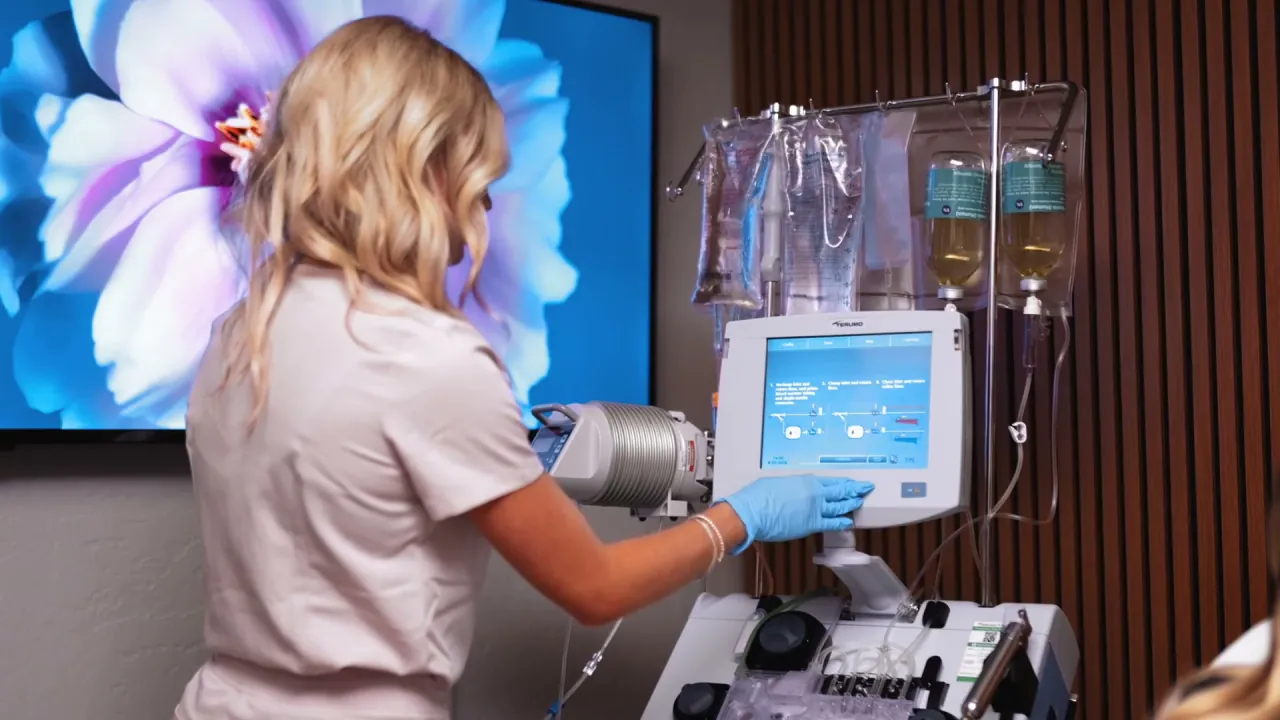
TPE's plasma-exchange mechanism removes a broad range of circulating inflammatory proteins and environmental compounds — the same general mechanism described on our Environmental Exposure and Biological Age pages, applied here to the two life stages above. That's a plausible mechanism for general wellness support, and a genuinely measurable one: markers like hs-CRP and an environmental-exposure panel move in a way you can see on a lab report, before and after. It is not a fertility or menopause-symptom claim.
The measurable case for perimenopause and menopause
Vasomotor symptoms — hot flashes and night sweats — affect an estimated 50% to 82% of U.S. women during the natural menopause transition, with roughly 87% of affected women reporting daily symptoms and a median symptom duration of four to more than ten years, per ACOG's practice guidance on menopausal symptom management.¹ This is a near-universal transition, not a niche concern, and it is a life stage where general wellness support may be relevant to your goals.
How it's approached today — menopause
Standard care is led by an OB/GYN, primary care physician, or menopause-trained specialist (including North American Menopause Society-certified practitioners) and centers on hormone therapy where appropriate, non-hormonal medication options, and lifestyle management, guided by an individual risk/benefit assessment.
Important limits
Menopause is associated with shifts in lipid profile, inflammatory markers, and metabolic risk that our Cardiovascular and Biological Age tracks are already built to measure and support. That is a plausible rationale for general wellness monitoring during this life stage — it is not evidence that TPE treats hot flashes, night sweats, or any other menopausal symptom, and there is no published clinical trial evidence that it does. A menopause-trained specialist reviewing your labs, not TPE itself, is what addresses your standard-of-care menopause management.
You might consider this track if you're...
- Preparing to conceive and interested in understanding your health baseline, alongside — never in place of — your OB/GYN or reproductive specialist
- In perimenopause or menopause and interested in general wellness monitoring of the metabolic and inflammatory shifts associated with this life stage, alongside — never in place of — your OB/GYN, PCP, or menopause specialist
- Already engaged in the Biological Age or Environmental Exposure track and want that same general wellness support during this specific life stage
- Not pregnant, actively trying to conceive, or in active fertility treatment — for patient safety, we do not provide TPE in those cases
- Not currently in symptomatic menopause management — if you are, talk to your treating specialist before adding any elective wellness protocol
References
- American College of Obstetricians and Gynecologists. Practice Bulletin No. 141: management of menopausal symptoms. Obstet Gynecol. 2014;123(1):202-216. Reaffirmed 2024.
TPE is not a fertility or menopause treatment and is not intended to diagnose, treat, cure, or prevent infertility, menopausal symptoms, or any other medical condition. It does not replace care from an OB/GYN, reproductive endocrinologist, or menopause specialist, and patients undergoing active infertility treatment or symptomatic menopause management should consult their treating specialist before adding any elective wellness protocol.
Questions worth asking any clinic, including ours.
Before you decide, ask us these. We’ll answer them plainly.
- What is the evidence for this use of TPE, and how strong is it?
- What will my Focused panel measure, what would an Expanded panel add, and how will we know what changed?
- What are the risks, and who should not have this procedure?
- What will it cost in total? (The Focused panel is included; the Expanded panel is an additional fee.)
- How will my own physician or clinician be kept informed?
Call us or send a request online, and our clinical team will answer your questions and set up a consultation.
Visit or call the clinic
Blood Rehabilitation Centers, Scottsdale, Arizona. Call us or send a request online, and our clinical team will answer your questions and set up a consultation.
Call (623) 294-5577- 8090 N. 85th Way, Suite 100, Scottsdale, AZ 85258
- Monday to Friday, 9 a.m. to 5 p.m.
What would you like to understand?
Browse all pages
- Home
- Blood Rehabilitation
- How We Prove It
- Programs
- The Vitality Cascade
- Membership
- TPE / Plasmapheresis
- TPE Fees & Packages
- How ClearCycle™ TPE Works
- The Evidence Behind TPE
- TPE Patient Experience
- eBoo
- EBO2 Fees & Packages
- How EBO2 Works
- EBO2 Patient Experience
- Safety & Standards
- Dr. David George
- Team
- For referring clinicians
- Contact Us in Scottsdale
- Frequently Asked Questions
- Privacy
- Terms & Conditions
- Cookie Policy
- Accessibility
- TPE for Biological Age
- TPE for Autoimmune & Chronic Inflammatory Conditions
- TPE for Cardiovascular Health
- TPE for Brain Health & Cognitive Function
- TPE for Environmental Exposure: Mold, Microplastics & Environmental Toxins
- TPE for Women’s Health
- Cardiovascular Health Program
- Biological Age
- Brain Health
- Autoimmune
- Environmental Exposure Program
- Women’s Health
- Performance Blood Health
- AMBAR trial summary